Pay Your Interns Campaign
Experiential Design
Despite growing movements demanding paid internships, unpaid roles continue to appear across the creative industry. “Pay Your Interns” campaign challenges this normalization through bold copywriting and unconventional placement. Grounded in research on hiring patterns and economic barriers for entry-level designers, the campaign uses design as activism to promote visibility and accountability in the workplace.
Role: Designer
Type: Independent Project
Duration: Spring 2022
Deliverables: Campaign Strategy, Copywriting, Print Design, Installation, Social Media.
Creative Process + Strategy
I began by exploring both sides of the issue:
Why employers resist paying interns (“budget,” “experience = payment,” etc.)
What motivates change (“brand reputation,” “employee culture,” “public perception”)
From these insights, I defined a communication goal: Make fairness feel like good business.


First Round of Design Exploration
Initial poster explorations focused on bold typography and an activist tone. This was effective visually, but unlikely to reach and capture the attention of the intended audience within office settings.


Second Round of Design Exploration
In this round, I decided to go in a completely new direction. Since the goal is to get employers attention, a poster most likely wont achieve that.
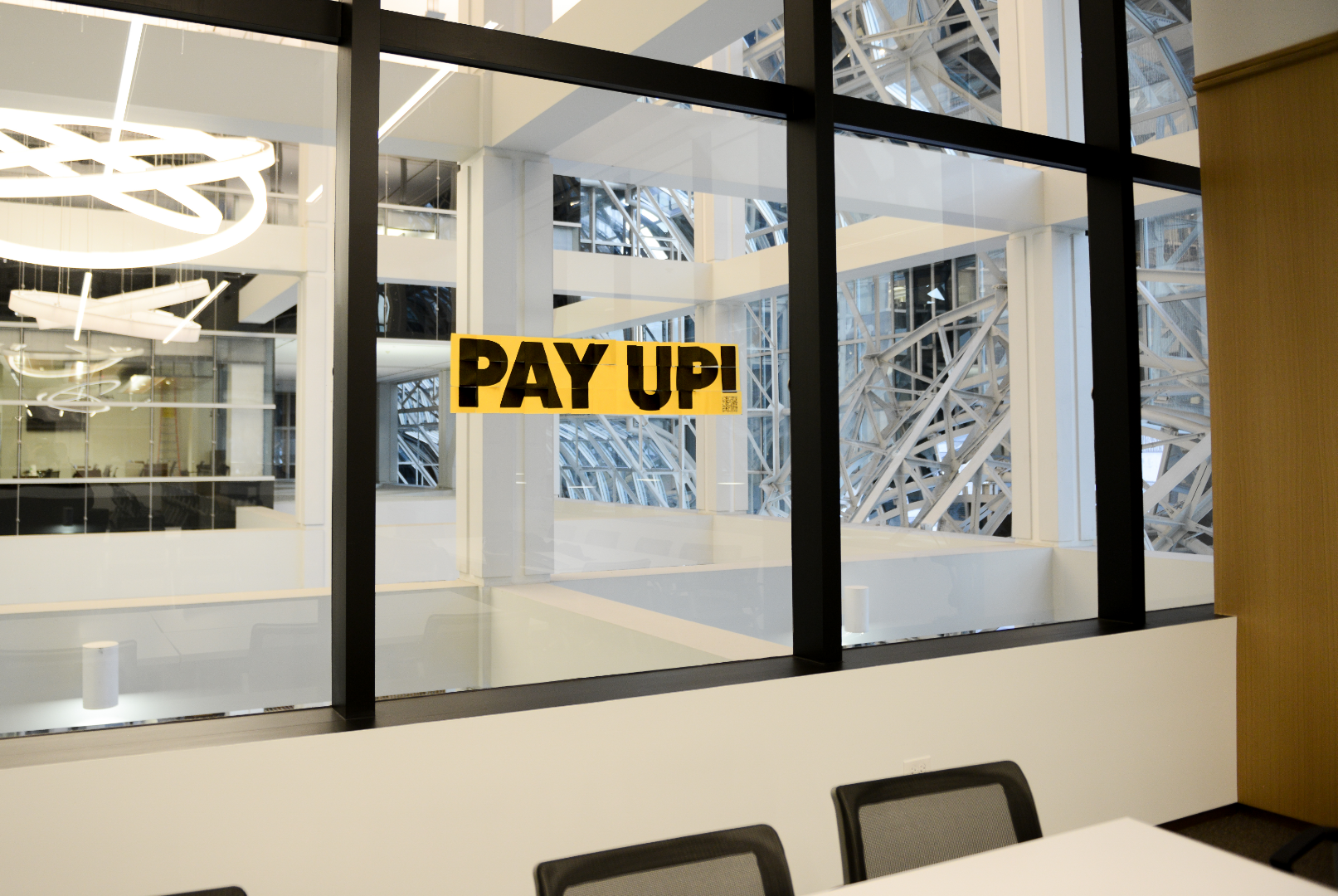
Instead, I decided to explore post-it notes, which are found around every office. I explored printing on post-it notes and wanted to create an experiential installation inside a communal office space.


Final Design Outcomes
The question driving this idea was simple:
“What if we could confront unethical hiring practices in the environments where they happen?”
Posters are easy to overlook, but Post-it notes are part of the everyday workflow. By reimagining a familiar office tool, the campaign transformed an ordinary object into a subtle intervention that prompted reflection and accountability.
The piece featured a QR code linking to a LinkedIn article I wrote about hiring paid interns, bridging in-person awareness with a broader digital conversation. This approach connected design thinking with real-world behavior change and extended the message beyond a single workspace.